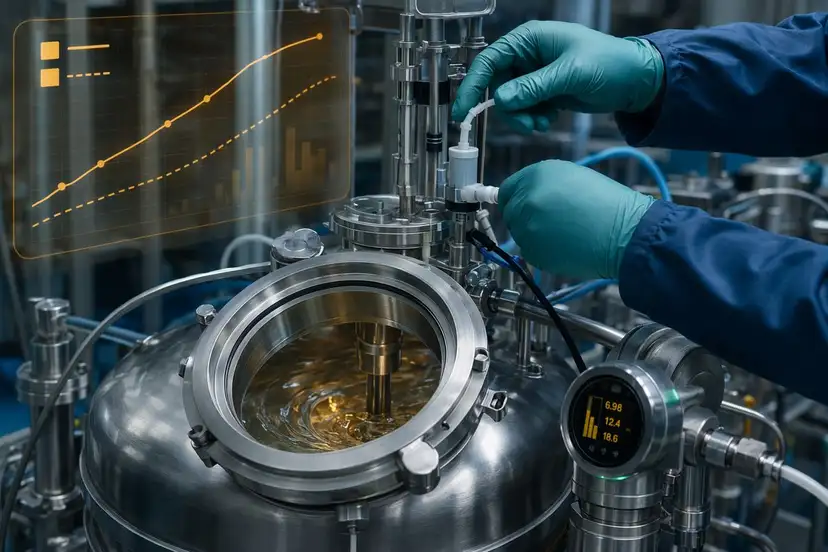
Enzyme Pilot Questions for Factory Process Managers
A practical checklist for process improvement managers planning an enzyme pilot: define the process problem, measurements, constraints, and stop-go criteria before plant validation.
Request pricing A practical checklist for process improvement managers planning an enzyme pilot: define the process problem, measurements, constraints, and stop-go criteria before plant validation.
Request pricingAn enzyme pilot should not begin with a product sample. It should begin with a controlled question.
For process improvement managers, the commercial risk is rarely whether an enzyme can do something in a beaker. The real question is whether a candidate enzyme can improve a defined factory process under real constraints: existing equipment, shift patterns, raw material variation, cleaning windows, downstream quality limits, and finance-approved performance targets.
Yieldwright Labs supports factories as an industrial enzyme trial supplier for factories by structuring the path from process diagnosis to plant-floor validation. The aim is not to add complexity. It is to prevent loose trials, unclear results, and avoidable production disruption.
Use the checklist below before authorising any enzyme pilot.
A pilot needs a narrow target. “Improve yield” or “reduce waste” is not specific enough for a plant trial.
Define the process problem in operational language:
The best pilot question is measurable and bounded. For example: “Can enzymatic treatment reduce holding time before separation without increasing off-spec risk?” That gives the trial a process location, a success condition, and a quality guardrail.
A factory enzyme trial must respect the process envelope. Before candidate selection, document where the enzyme can realistically be introduced and how it will be controlled.
Clarify:
This prevents a common failure mode: recommending an enzyme that works under ideal conditions but does not fit the plant.
A pilot is only as strong as its baseline. If baseline performance is noisy, seasonal, or poorly sampled, trial results will be difficult to defend.
Before dosing anything, agree which baseline window is acceptable. Include:
If baseline variation is high, the trial design should account for it. In some plants, that means paired runs. In others, it means alternating control and enzyme-treated batches over a defined campaign.
An enzyme pilot should have primary and secondary KPIs. Without hierarchy, every result becomes debatable.
Choose one or two decision KPIs tied directly to the business case:
Track supporting signals, but do not let them override the main decision:
Commercially useful trials separate “interesting” from “decision-grade.”
Stop-go criteria protect both the plant and the project budget. They also prevent trial results from being reinterpreted after the fact.
Set criteria in advance for:
A practical pilot does not need dozens of metrics. It needs a few metrics that the operations, quality, and finance stakeholders all accept.
Bigger is not always better. The right trial scale is the smallest one that produces reliable evidence for the next decision.
Typical progression may include:
Skipping steps can look fast, but it often creates rework. Over-testing can also waste time. The correct sequence depends on risk: raw material cost, line availability, off-spec exposure, and the consequences of downstream disruption.
Enzyme pilots touch multiple functions. Assign ownership before the first sample is prepared.
At minimum, define responsibility for:
When ownership is vague, trials drift. When ownership is explicit, the pilot becomes an operational project rather than a side experiment.
Some enzyme candidates work technically but fail commercially. Ask this early.
Potential blockers include:
A credible supplier should help identify these risks before the pilot, not after purchase discussions begin.
A useful enzyme trial partner should provide more than candidate selection.
Ask for:
This is where a structured industrial enzyme trial supplier for factories can create value: not by promising a universal solution, but by making the trial defensible.
Every pilot should end with one of four decisions:
A “maybe” is usually a sign that the pilot question was too loose or the measurement plan was not strong enough.
Before approving the pilot, confirm the following:
Yieldwright Labs helps industrial teams structure enzyme trials around plant reality. We review the process problem, identify trial constraints, recommend candidate approaches, define KPI logic, and help convert lab findings into production-floor validation plans.
Our role is to reduce trial ambiguity: what is being tested, why it matters, how it will be measured, and what decision follows.
If you are evaluating an enzyme route for a factory process, share the process step, current constraint, target KPI, and any known operating limits. Yieldwright Labs can scope a practical trial pathway and quote the support required.
Tell us your application and volume — we reply with pricing and lead time.